


Building backlinks is inherently good for your website. It ensures better search engine rankings, more traffic, and ultimately, more revenue for your business. In other words, links are one of the strongest ranking factors out there.
However, building links on your own can be very costly and time-consuming. You need at least one in-house SEO expert and knowledge of how the link building industry works. And as we previously wrote, hiring in-house is not always the cheapest option. And there is the option of paying “administration fees” to website owners for adding a link to their website.
So, you might be tempted to buy backlinks. But now you’re left wondering – is this against Google’s guidelines? Will I get punished and what kind of results can I expect from backlink services? We’ll explain everything today.
What does it mean to buy backlinks?
If you buy backlinks, that means you’re exchanging money in return for backlinks pointing from other websites to yours. If you take a look at things this way, most backlinks are bought. The only ones that are not are those in the minority that get earned. In other words, the situation when someone naturally links to your website without you asking for it.
As someone who’s been in link building for over a decade, I can tell you this is very rare.
When you think about it, the majority of links are bought in one of three ways:
- You personally spend your time doing outreach to sites.
- You pay an agency or a freelancer to build backlinks or you hire someone who builds links in-house, does outreach to get niche edits, writes guest posts, and more.
- You pay a website owner to add your link to their website for a placement or administration fee.
The difference is only in how much the link costs. And while it may sound like it’s cheaper to outright buy links from a website, it’s actually riskier as no one can guarantee those links.
The bottom line is – do not be afraid to buy backlinks from agencies and freelancers as it is a very common practice. When done right, link building services can yield amazing results. The most important thing is to stay away from purchasing links from website owners – but there are other pitfalls to watch out for.
Is buying links against Google’s guidelines?
Google says quite a few things about link schemes and that participating in them can get your website penalized, either automatically or manually. Specifically, exchanging money or goods or services for links is frowned upon. So, buying links outright is against guidelines by Google.
However, hiring agencies and link builders and paying them to build the links for you in a legitimate way is the safe way to go about things.
And as we can see from our own clients and other websites that invest in SEO, backlinks get results and the pages with those links have higher rankings, better domain authority, and increased organic traffic.
So it is technically against Google’s guidelines to buy backlinks, but you can try and “bend the rules”. If you do this, it’s best to avoid links from websites that outright offer to sell backlinks for a “placement fee”, as well as PBNs (private blog networks).
If you can buy a backlink from these websites – so can anyone else. This means that you’re getting a type of link that anyone else can get, which immediately puts less value on it. Also, once that website that sells links gets penalized, you might be in trouble too as the website that has toxic links pointing to it.
In short, it’s not against the guidelines, but use caution and be careful where you get links from. In the end, the only real way to buy backlinks is from reputable agencies and link builders.
How much does it cost to buy links?
As we recently wrote, it really depends on the method you use to buy quality backlinks.
As for paying a website owner to add your backlink, the fees vary from one website to the next. Ahrefs estimates it costs on average $360/link for direct payment. This comes with no guarantees that the link will stay there for any given amount of time.
On the other hand, purchasing backlinks by hiring a marketing agency or a freelancer is the safer way to go. If you hire ReportCard, links will cost on average $250/link.
Does this mean that you cannot build backlinks for less money? Of course not.
You can find opportunities to buy a good quality backlink for $200 or even $100 per link but those chances for purchasing backlinks are few and far between. And if you take the risk of purchasing links from a website owner or manager, you never know if that link is going to stay and if it gets removed with the next content update.
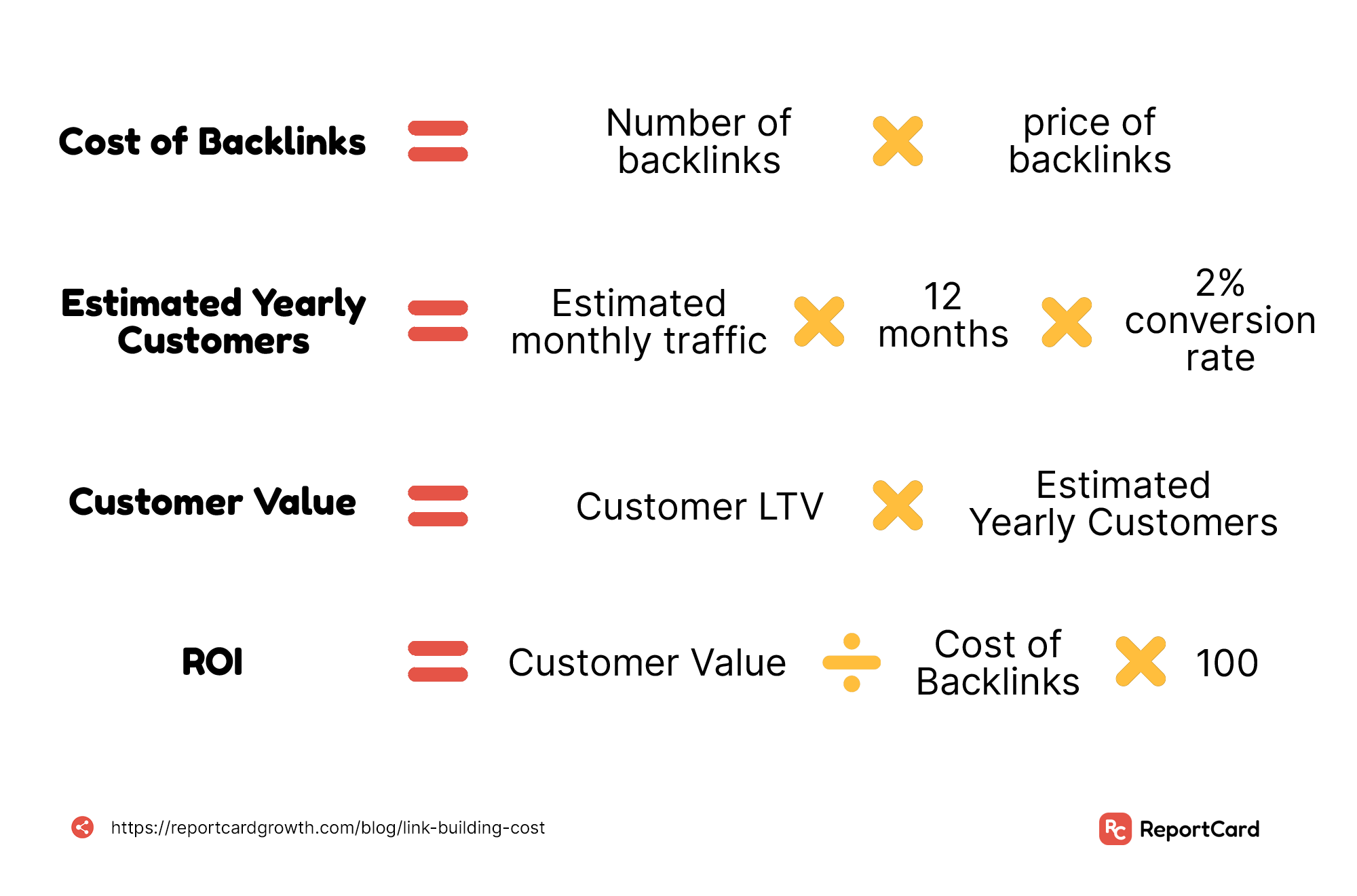
Instead of primarily looking at how much the backlinks cost, consider the quality and ROI. If a backlink comes from a high-quality page with a good domain rating and the context is relevant, then the average cost of $250 per backlink is very much justified as it will lead to better search engine results.
Below is an image explaining how we calculate potential ROI of link building:
What to look for when buying backlinks?
Buying links as an SEO strategy is not harmful to your website when done right. But here is the catch – what should you look for when buying backlinks to avoid getting your website penalized? Here are some of the most common things to look out for with this type of SEO service.
-
The overall quality of the website
The website you’re getting a link from should belong to an actual business. You should avoid personal blogs, aggregators, and websites that cover a wide range of topics and ideas.
The website should be easy to navigate, with a good user experience and a clear purpose. There should be no shady blog posts or links around topics such as gambling, drugs, or pornography (unless you’re in those industries).
There should be no immediate offer from the website owners to purchase a link from the website. Once again, there are plenty of websites where owners explicitly offer to give backlinks for a certain amount of money. If Google can clearly see they sell links, you are at a higher risk for penalty or Google ignoring the value from that link.
-
The relevance of the page you’re getting a link from
Let’s say that you sell medical equipment for dentists. When buying backlinks to your website, you should try and get them from other medical websites that are related to the topic. Think private clinics, industry blogs covering medical topics, websites made by clinicians for patients, etc.
However, you can get a link from a more general website that is not so closely tied to the topic. For example, you could get a link from a toothpaste review on a consumer website that is relevant to your business.
On the other hand, getting a backlink to a dental equipment web page from a website that sells gardening hoses probably will not do much for your SEO. Despite the website’s ranking, this would be a poor link to get.
The context around the anchor text of your link should be relevant too. You can’t insert a link to dental equipment in a paragraph about collagen lip fillers as it will look spammy and unnatural, and stick out in your link profile.
Last but not least, you can get two types of backlinks: no-follow and do-follow. Both are good for your backlink profile and rankings in the SERPs, but whenever you can, buy do-follow links only. No-follow links are not a black hat tactic that will lead to a Google penalty, but they simply do not hold as much weight as the do-follow ones.
-
The domain rating of the website
One of the most important criteria for link building is the domain rating (DR) of the website that you’re getting a link from. Domain rating is a metric established by the SEO tool Ahrefs, and it determines a score for a website, on a scale from 0 to 100. The closer the website you’re getting a link from is to 100, the better.

Most agencies and freelancers offer link building packages with links in domain rating ranges. For example, we recommend building links from DR30+ websites.
We can’t tell you which domain rating is ideal to get a backlink from because it depends on the DR of your own website, as well as the goal you want to achieve. Sometimes, a DR40 link can push page rankings for a page better than a DR80 link from an irrelevant source.
In other words, consult with your backlink agency or freelancer. They will tell you what kind of DR range is optimal for the goals you want to achieve and the results you want in Google search. Higher is better, but that does not mean you should spend thousands of dollars chasing DR80+ links only.
-
The traffic of the website you’re getting a link from
If you take a look at your target website in any good SEO tool (Ahrefs, SEMRush), you can also see the traffic of a website you’re getting a link from. This traffic is measured in the number of visits per month. The more traffic, the better. For example, a value that is generally considered acceptable is anything with at least 1,500 monthly visits.

You’ll want to get SEO backlinks from websites with a good amount of website traffic as this means they’re legitimate and have quality content. There are websites with a high domain rating but very low traffic, which is a pretty good sign that something is off and these will be low-quality links. The website is probably part of some private blog networks or has been penalized in a Google algorithm update.
Speaking of which, you can also see the traffic trends from a website analysis in these SEO tools. Watch out for sharp spikes and drops as that means something major happened – such as getting hit with a penalty. You want a gradual curve that goes upwards as time progresses.
Ideally, you want the page that the link is coming from to have some traffic as well. If the page is getting visits and there is a link from it to your website, there is a good chance that you might get some referral traffic and have people come from that page to yours.
Are there any risks in buying links?
As most search engine optimization experts love to say – it depends. If you’re buying links from reputable agencies and freelancers who use white hat SEO methods, then the risks are minimal or non-existent.
If you buy links from dodgy websites with countless topics, questionable traffic, and poor domain rating, you’ll be on the wrong end of Google’s penalty stick, sooner or later.
The risks with buying links from a website are plenty. Your links could get removed by the website admin once the payment comes through. The website could be identified as a part of a PBN and hit with a manual penalty and you could lose the link and have to disavow it. The admin could replace your link or add a link next to it that leads to shady websites for medication and adult movies – or something along those lines.
In short, there are little to no risk if you’re buying links from an agency or a freelancer. If you’re buying from a website, you could be looking at some trouble in the future.
Buy backlinks with confidence
At ReportCard, we’ve been building backlinks for websites in very competitive verticals for years and we know what makes for a high-quality backlink for our clients. With our experience, you’re certain you’re buying great backlinks from reputable domains and improving your search rankings.
Ready to get started? Book your free consultation call today so we can see how we can help you and your business.