


If you’re new to the world of SEO, there are countless terms to get familiar with. You are probably aware of the effect that backlinks have on rankings and that earning these backlinks can be profitable for your business.
But then, there are also certain traps you have to watch out for. Poor-quality backlinks can do more harm than good. One of those link building practices that are extremely risky is called PBN backlinks.
Today, we’re going to explain what these backlinks are and why you should avoid them.
What is a PBN?
A PBN or a private blog network is a group of websites owned by the same person or company. The main purpose of these websites is to provide links to one main website (usually called the money site) so it can rank better in search engines.
Instead of earning high-quality backlinks from authoritative websites, website owners use their own sites to push the authority of their main target website. These are PBN sites that usually have little to no value other than giving links to their main website.

PBNs are generally considered a black hat SEO tactic that is not in favor of Google’s algorithm. Most digital marketing agencies stay away from this link building strategy.
How do you build a PBN?
In essence, a PBN is a network of websites. And as anyone who’s ever built a website knows, getting a website up from scratch to good traffic and SEO performance is very time-consuming and expensive.
Naturally, if you want PBN links, you don’t have that time. This is why bloggers resort to other methods to boost their link profiles.
Usually, PBN owners buy expired domains and then use their authority and link juice to build their PBN network. In other words, when a website (let’s say example.com) has hit the expiry date and the owner does not renew it, a PBN blogger purchases the domain. Usually, the domain expires simply because someone forgets to renew it.
The PBN blogger then hosts their own website on this expired domain, complete with its IP address. To Google and other search engines, the new website has the same domain, and it also inherits the entire backlink profile from the old website.
In short, they masked their own website to look like it belongs on a domain that was someone else’s. This is a legitimate way to earn domain reputation and many businesses use this tactic to improve their search engine rankings.
The problem is, PBN bloggers use it exclusively to build links to one website, which is a pretty spammy tactic and rarely involves high domain authority websites.
So, what is the problem with PBN backlinks?
Given the description above, you may think that getting backlinks to your own website from a PBN may not be such a bad idea. In reality, you’re risking quite a bit if you’re using these websites to generate backlinks.
Google does not explicitly say anything about private blog networks as an SEO strategy. However, there are many instances where they mention that any website participating in link schemes can and will be penalized.
Google is pretty good at rolling out automatic updates that punish websites with suspicious links. If you build links from PBNs, do not be surprised if you see a sudden drop in traffic or a major loss of keywords that are ranking, or a huge change in other metrics that you may be tracking.
The worst possible scenario is a manual penalty from Google. This happens when an actual person analyzes your website and determines that there is something suspicious going on. A manual penalty could mean that your website loses its entire presence on search engines and you stop ranking for all of your keywords. You practically become invisible.
Should you build or buy PBN links?
The short answer is – no. Backlinks from PBNs can work in the short run but eventually become a liability. As soon as one website in the network is exposed, the entire PBN can be hit with a penalty. But let’s go into some more detail.
- If you want to build your own PBN, it is very costly and time-consuming to get it up and running. You’ll need to buy multiple website domains and point them to your own websites that you have to build and maintain.
- If you decide that you no longer need these websites after a while, selling them can be very difficult. With thin content or no content at all, and their main purpose just to give external links to other websites, they are a hard sell.
- Since these websites usually have little to no value and there is no quality content on them, you might not see any movements in SERPs from the backlinks that you build.
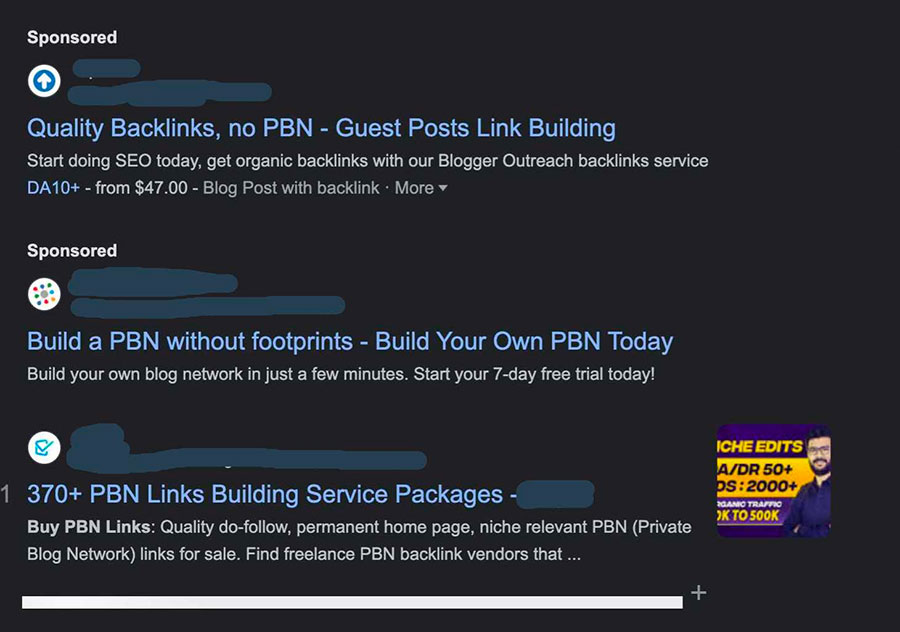
Once more, you should really avoid building backlinks from PBNs, whether you do it on your own or use an agency for your link building efforts. Speaking of which…
How do I know if an agency I hired is building links with PBNs?
Unfortunately, it can be difficult to figure out, especially if it is a larger network of websites. If the PBN has several dozen websites, you might not figure out what is happening at all until it may be too late.
However, here are some practical tips for making sure that the links you get from a link building agency are legitimate and not low-quality PBN links.
- Check the page that the link is coming from and make sure that the anchor text and the link are contextually relevant.
- Check the entire website that the link is coming from in an SEO tool such as Ahrefs. Avoid websites that have a good domain rating but no website traffic. Also, avoid websites with sudden drops or spikes in traffic as those will not yield authority links.
- Take a good look at the website. Does it sell an actual product or service? Does it represent an actual business or is it just a news/aggregator website?
- Ask the agency about the tactics they use for building links. They should list the most common white hat techniques such as guest posts, link exchanges, PR outreach through platforms like HARO, niche insertions, and more for building quality links. Ask them about the number of links they can build monthly – too many can be a red flag that something is off.
As we mentioned, it can be pretty difficult to figure out if an agency is indeed using PBN backlinks. For this reason, it’s best to rely on agency reviews and referrals from your network and hire a reputable agency that you can trust.
Last but not least, stay away from cheap links because good links cost money.
I built links to my website from PBNs. Now what?
It’s not the end of the world. In fact, practice has shown that there is a huge discrepancy between what search engines such as Google state and what is actually being done in the real world.
In theory, PBN backlinks should erase your website off the face of Earth (or Google) so they can never be found again. In practice, backlinks from PBN domains can stay up and relevant for months and years because they are flying under Google’s radar and they do not impact any site’s rankings.
However, don’t be fooled. Just because no one has penalized your website yet, it does not mean that it cannot or will not happen. All it takes is just one website in the network to get discovered. Before you know it, you could have a manual penalty to deal with.
In short, it’s not a question of if, but when you will get penalized for these unnatural links.
I have PBN links coming to my website and I wish to remove them. How do I do this?
If you run a website audit through a tool like Ahrefs or SEMRush, you can spot links that appear shady. Links with low domain ratings, irrelevant anchors, pointing to pages that have no impact on your business – these can all go.
However, don’t be so hasty. If your website is performing well and your organic traffic is steady or on the rise, leave the links as they are. Since there are seemingly no effects on the website, it means that Google is ignoring those links (or perceives them as good) for now and that your website’s rankings are safe.
If you do want to remove these links from your website, it’s actually pretty easy. All you have to do is create a disavow file with the domains you want to be removed from your backlink profile. The disavow file is then uploaded to your Google Search Console and you’re effectively telling Google to ignore these links.

Note that this process can take several weeks at a time.
The better alternative to building links from PBNs
While it can be tempting to get quick and cheap backlinks from a PBN, this is a tactic that can backfire, hard. As we’ve written before, there is no such thing as a good and cheap link.
The better alternative is to hire an agency to build your links from known and reputable sources. Good agencies avoid PBN websites as they are a potential hazard to their clients. The short-term increase in rankings are not worth the tarnished reputation in the long run.
If you want high-quality, relevant backlinks to your website, book a call with us today. We’ll make sure your backlink portfolio is spotless so that your website soars in search engine results pages.